
1. The High Cost of Disjointed Timesheets and Monthly Spreadsheet Chaos
Across hundreds of enterprises in Cambodia—from manufacturing facilities in the Phnom Penh Special Economic Zone to expanding restaurant chains in BKK1 and auto garages across Sen Sok—the final week of every calendar month brings intense administrative strain for human resources and finance personnel.
In organizations relying on fragmented manual tools, the monthly payroll journey resembles an exhausting scavenger hunt:
- Dispersed Paper Records: Gathering handwritten paper sign-in logbooks from three different branch entrances or security desks.
- Scattered Telegram Messaging: Scrolling through hundreds of chat threads across individual supervisors to locate photos of medical leave certificates, emergency leave requests, or informal overtime approvals.
- Fragile Excel Formulas: Copying attendance hours line by line into complex spreadsheets where a single misplaced decimal or broken VLOOKUP formula distorts social security deductions and overtime pay.
The consequences of this disjointed approach are severe:
- Wasted Productive Hours: HR directors report spending 4 to 6 full business days each month merely cleaning, reformatting, and reconciling attendance data before actual payroll calculations can begin.
- Costly Calculation Inaccuracies: Overpaying unworked hours or underpaying statutory overtime creates bitter employee grievances, distrust, and union disputes.
- Regulatory Audit Exposure: Inability to provide clear, tamper-proof audit trails during routine Ministry of Labour and Vocational Training (MoLVT) or General Department of Taxation (GDT) audits exposes the company to hefty penalties and interest charges.
To build an efficient, stress-free monthly operation, Cambodian HR leaders must replace improvised manual scrambling with a standardized, repeatable 7-stage attendance-to-payroll architecture.
2. The 7-Stage Cambodian Monthly Attendance-to-Payroll Architecture
A resilient monthly payroll workflow bridges frontline attendance collection with final banking disbursal through seven sequential checkpoints.
Stage 1: Real-Time Attendance Data Capture
Rather than waiting until the 28th of the month to gather attendance sheets, capture attendance continuously via digital mechanisms. With AttendKH's mobile attendance application, employee clock-ins and clock-outs are recorded in real time with anti-spoofing GPS coordinates and live front-camera selfies. For shared physical environments such as retail counters and workshop floors, workers scan their personal QR codes on a shared tablet kiosk in under 1 second.
Stage 2: Lateness, Absence & Missed Punch Reconciliation
Frontline employees occasionally forget to clock out at the end of a busy shift or experience device battery failure.
- The system automatically highlights anomalies: missed punches, unapproved early departures, or anomalous overtime.
- Employees submit correction requests directly through their smartphone app, accompanied by brief explanations.
- Immediate line supervisors review and approve corrections within 24 hours, ensuring the timesheet ledger remains fully clean before cut-off day.
Stage 3: Statutory Overtime Audit (Article 139)
Under the Cambodian Labour Law (Article 139), overtime must remain strictly voluntary, capped at a maximum of 2 hours per day, and compensated at mandated statutory multipliers:
- Standard Day Shift Overtime: 150% (1.5×) of base hourly rate.
- Night Shift Overtime (22:00–06:00): 200% (2.0×) of base hourly rate.
- Sunday / Weekly Rest Day: 200% (2.0× / Double Pay).
- Official Public Holidays: 200% (2.0×) in addition to regular public holiday wages.
The HR team must verify that all logged overtime hours have corresponding managerial approval and written consent forms on file, shielding the company from labor inspection penalties.
Stage 4: Statutory Leave Verification (Articles 166–183)
Reconcile all recorded absences against accrued leave balances:
- Paid Annual Leave (Article 166): 18 working days per year for full-time staff, with an additional +1 day for every 3 years of continuous tenure.
- Sick Leave: Certified by valid clinical medical certificates recognized by the MoLVT.
- Special Leave (Article 169): Up to 7 days per year for weddings, births, or immediate family deaths, which may be deducted from annual leave or handled per internal company regulations.
- Maternity Leave (Articles 182–183): 90 calendar days paid at 50% wages for employees with more than one year of continuous service.
Stage 5: Departmental & General Manager Sign-Off
Once branch supervisors verify their operational teams' hours, consolidated timesheets are locked against further edits. The General Manager or Operations Director reviews summary dashboards comparing total regular hours, overtime hours, and absent days across all branches.
Stage 6: Automated Payroll & Statutory Deductions Computation
With verified attendance figures locked, the payroll engine computes gross-to-net calculations:
- Dual-Currency Conversion: Applying the official National Bank of Cambodia (NBC) market exchange rate published on the 15th of the taxable month for GDT tax filings.
- Progressive Tax on Salary (ToS): Calculating statutory brackets (0%, 5%, 10%, 15%, 20%) with applicable family relief deductions (៛150,000 KHR per dependent minor child or non-working spouse).
- NSSF Deductions: Deducting statutory contributions (Health Care 2.6% employee + 2.6% employer; Pension Scheme 2.0% employee + 2.0% employer) capped at the statutory ceiling (approximately ៛1,200,000 KHR).
- Seniority Indemnity Accruals (Prakas 443/18): Accruing semi-annual indemnity payments (7.5 days in June, 7.5 days in December for UDC staff).
Learn more about statutory tax brackets in our dedicated guide on Cambodia Tax on Salary brackets and GDT payroll handbook.
Stage 7: Itemized Bilingual Payslip Generation & NBC Bakong KHQR Disbursal
Once payroll is finalized:
- Generate itemized bilingual (Khmer & English) digital payslips showing gross salary, overtime breakdowns, tax withholdings, NSSF deductions, and net payable earnings.
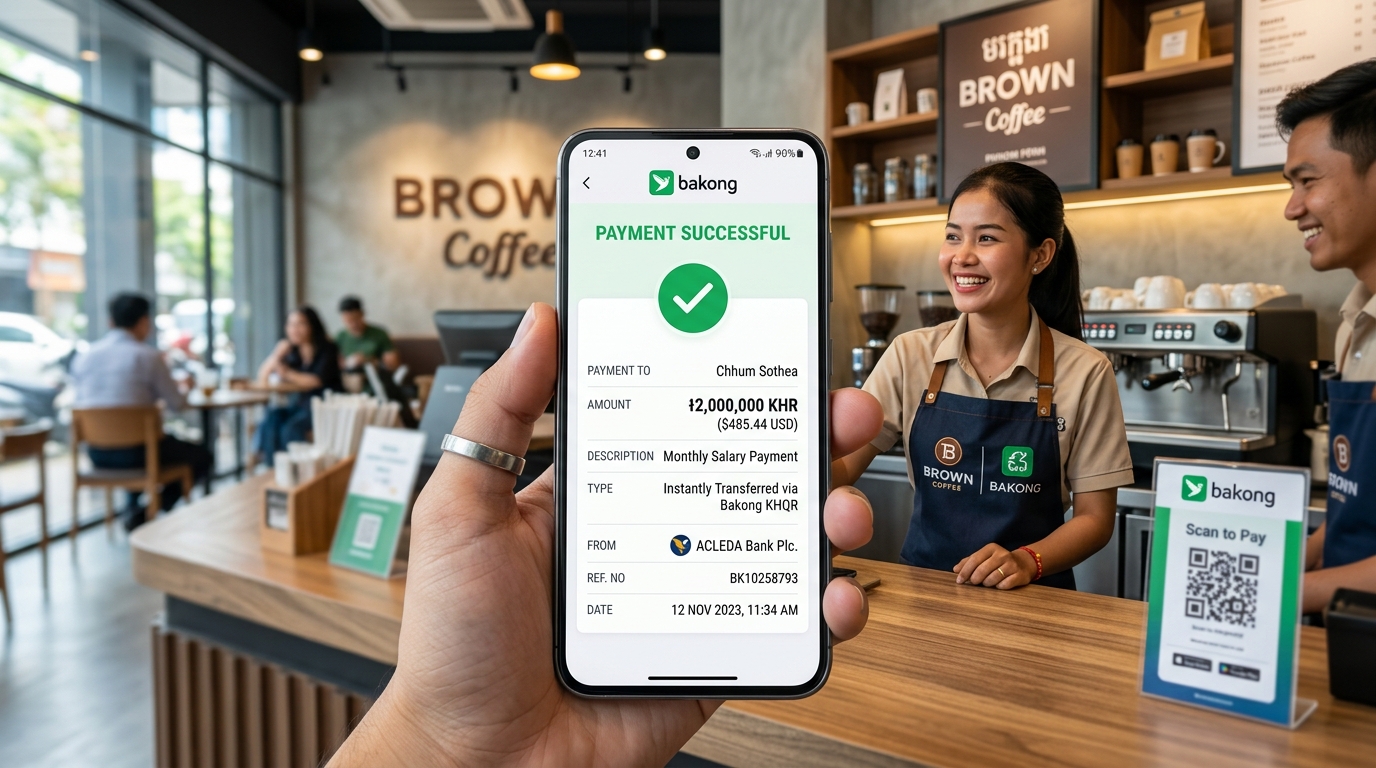
- Export direct payroll batch files for corporate banking, or disburse salaries instantly with zero transaction fees to 50+ commercial banks via NBC Bakong KHQR bulk payroll disbursal.
3. Establishing Strict Cut-Off Periods and Immutable Audit Trails
A primary reason payroll teams face chaotic end-of-month all-nighters is the lack of a formalized payroll cut-off date. When employees are permitted to submit leave slips or overtime corrections on the morning of payday, calculation errors become inevitable.
Selecting the Right Cut-Off Window
For businesses paying salaries on the final day of the calendar month (e.g. 30th or 31st), establish an explicit cut-off date:
- Option A (26th to 25th Cycle): Attendance from the 26th of the prior month to the 25th of the current month. This provides HR with 5 full business days to verify data, process approvals, and coordinate with finance.
- Option B (21st to 20th Cycle): Recommended for multi-branch retail or manufacturing companies with 100+ employees requiring multi-tiered management approvals.
Crucial Policy Rule: Announce an unyielding cut-off deadline. Any overtime claims, expense reimbursements, or leave adjustments submitted after 17:00 on cut-off day automatically roll over into the subsequent month's payroll cycle.
The Value of Immutable Audit Trails
Under MoLVT inspection guidelines, employers must retain timesheets, overtime logs, and signed salary payment receipts for a minimum of three years. Modern cloud systems like AttendKH automatically preserve tamper-proof digital records:
- Who approved the overtime adjustment and at what exact second.
- Verified GPS coordinates and front-camera selfie snapshots for every shift punch.
- Complete version histories showing every modification to gross base wages or tax relief status.
4. Eliminating Duplicate Data Entry Across Multi-Branch Operations
For multi-branch enterprises—such as a hospitality brand operating three venues in Phnom Penh, two in Siem Reap, and one in Sihanoukville—manual payroll is exponentially more complex.
Traditional companies force branch supervisors to compile separate weekly Excel files and email them to the Phnom Penh headquarters. The central HR manager then spends days copying rows into a master spreadsheet, dealing with mismatched formatting, corrupted formulas, and conflicting employee ID numbers.
By unifying all locations onto a centralized cloud database:
- Single Source of Truth: When an employee clocks in at the Siem Reap branch, their hours appear immediately on the central Phnom Penh dashboard.
- Role-Based Approvals: Branch managers possess restricted permissions to review and approve only their local branch's shift records. They cannot alter wage rates or view company-wide financials.
- Seamless Roaming Staff: Frontline technicians or roving retail staff who work across multiple branches are tracked seamlessly without double-counting hours or distorting individual branch labor costs.
Explore our comprehensive analysis on managing attendance across multiple branches in Cambodia.
5. The Monthly Payroll Preparation Checklist & Common Traps to Avoid
Compare the operational efficiency of manual processing against a modern automated workflow:
| Workflow Phase | Manual Spreadsheets & Paper | AttendKH Automated Workflow |
|---|---|---|
| Timesheet Aggregation | 16–24 hours (collecting paper, typing rows) | 0 hours (continuous real-time sync) |
| Overtime Calculation | 8–12 hours (manual multiplier math) | Instantaneous automated calculation |
| Leave Reconciliation | 6–8 hours (searching Telegram chats) | 1-click synced approval balance |
| Tax & NSSF Calculations | 6–10 hours (complex Excel formulas) | Automated GDT brackets & NSSF caps |
| Payslip Distribution | 4–6 hours (printing paper slips) | Instant digital delivery to mobile app |
| Bank Disbursal | Manual CSV reformatting or cash envelopes | 1-click NBC Bakong KHQR batch payout |
| Total HR Time Invested | 40 to 60 Hours Monthly | Under 2 Hours Monthly |
The Monthly Payroll Preparation Checklist
T-minus 5 Days (Cut-Off Day - e.g. 25th)
- Freeze timesheet edits across all branches.
- Require supervisors to clear all pending missed-punch and shift-swap requests.
- Confirm all approved sick leaves have clinical medical certificates attached.
T-minus 4 Days (Overtime & Leave Audit - e.g. 26th)
- Verify that daily overtime totals comply with the 2-hour daily maximum (Article 139).
- Verify that Sunday and holiday shifts are correctly tagged with 200% statutory multipliers.
- Obtain formal departmental manager sign-offs.
T-minus 3 Days (Tax & Statutory Deductions - e.g. 27th)
- Sync the official NBC market exchange rate issued on the 15th of the taxable month.
- Apply progressive GDT Tax on Salary brackets and family relief deductions.
- Verify NSSF Health Care (2.6% + 2.6%) and Pension (2.0% + 2.0%) caps.
T-minus 2 Days (Executive Approval & Finance Review - e.g. 28th)
- Submit executive summary payroll report to CEO/CFO for final budget sign-off.
- Confirm bank account balances or Bakong corporate settlement balances.
T-minus 1 Day / Payday (Disbursal & Payslips - e.g. 30th)
- Execute bulk salary disbursal via corporate banking batch or instant Bakong KHQR.
- Release itemized bilingual digital payslips to employee mobile apps.
Common Payroll Traps to Avoid
- Using Unofficial Exchange Rates: Calculating Tax on Salary using commercial bank exchange rates or market black-market rates instead of the official National Bank of Cambodia rate issued on the 15th of the month.
- Forgetting the NSSF Salary Ceiling: Calculating NSSF contributions on an executive's full $2,500 base salary instead of capping the contribution at the statutory wage limit (~៛1,200,000 KHR).
- Misclassifying Public Holiday Work: Paying regular 150% overtime instead of the mandatory 200% double-pay multiplier for shifts worked on official public holidays designated by the annual royal sub-decree (Prakas).
6. Building a Repeatable, Stress-Free HR Operating Rhythm
Transitioning your enterprise from chaotic spreadsheet panic to an automated, predictable payroll engine does not require enterprise-level budgets or months of software development.
By adopting AttendKH's unified workforce platform at just $1 USD per employee per month, your team gains:
- Real-time mobile GPS and QR kiosk attendance capture with zero hardware investments.
- Automated compliance with MoLVT overtime formulas, annual leave entitlements, and GDT tax brackets.
- Instant, zero-fee salary disbursal across 50+ Cambodian financial institutions via NBC Bakong KHQR.
- Dedicated local onboarding and technical support from our Phnom Penh engineering team.
Discover our straightforward $1/user pricing, download the iOS and Android apps, or schedule a personalized product walkthrough with our specialists today.