
1. Why Overtime is the #1 Source of Payroll Friction in Cambodia
For human resources directors, finance managers, and business owners across Cambodia, calculating monthly overtime (OT) is consistently the most stressful phase of the monthly payroll cycle.
A single manufacturing workshop in the Phnom Penh Special Economic Zone (PPSEZ), an auto repair garage in Chamkarmon, or a multi-branch restaurant chain with 60 frontline service staff generates thousands of individual time records every month. When these clock-in timestamps are transcribed by hand from paper sign-in sheets or exported from disconnected fingerprint machines into shared Excel spreadsheets, discrepancies are mathematically inevitable:
- Staff claim 45 minutes of overtime because they clocked out at 18:15, even though their shift ended at 17:30 and no manager authorized overtime work.
- Shift managers manually write OT hours on scraps of paper or send unorganized Telegram voice notes that get buried in group chats.
- Accountants apply incorrect multiplier rates—paying 1.5× for Sunday overtime instead of the legally mandated 2.0× double-pay rate required by the Ministry of Labour and Vocational Training (MoLVT).
Regulatory Compliance Reality: Under Article 139 of the Cambodian Labour Law, overtime must always remain strictly voluntary and is capped at maximum 2 hours per day. Forcing or allowing undocumented, unapproved overtime not only inflates your wage bill by 15% to 25%, but also exposes your enterprise to severe penalties during routine MoLVT labor inspections and Better Factories Cambodia (BFC) compliance audits.
To eliminate wage disputes, protect employee morale, and safeguard company margins, businesses must implement a transparent, audit-ready overtime tracking workflow. Here is the operational playbook.
2. Scheduled Hours vs. Actual Hours: The Core Conceptual Difference
The primary reason spreadsheets fail in overtime calculations is the inability to distinguish between scheduled hours and actual punch hours.
Consider a typical retail or office schedule in Phnom Penh:
- Scheduled Working Hours: 08:00 to 17:00 (8 working hours + 1 unpaid lunch hour).
- Employee Clock-in: 07:42 (18 minutes early).
- Employee Clock-out: 17:28 (28 minutes late).
If a basic Excel formula simply subtracts the clock-in timestamp from the clock-out timestamp, it calculates a total span of 9 hours and 46 minutes. Subtracting the 1-hour lunch break leaves 8 hours and 46 minutes, erroneously generating 46 minutes of payable overtime.
However, in reality:
- Arriving 18 minutes early to drink coffee or change into uniform is not compensable working overtime unless specifically directed in writing by management.
- Departing 28 minutes late due to chatting with colleagues or waiting for evening traffic on Monivong Boulevard to subside does not constitute authorized overtime labor.
The Solution: Shift Buffers & Grace Periods
A compliant digital system like AttendKH solves this issue through automated shift rule enforcement:
- Arrival Grace Window: Early clock-ins automatically snap to the scheduled shift start time (08:00) unless an authorized overtime pre-approval exists.
- Overtime Threshold Buffer: Departing 10 or 15 minutes after shift end does not trigger automatic overtime. Overtime calculations only initiate when actual working time exceeds a defined threshold (e.g., minimum 30 continuous minutes) and is backed by managerial sign-off.
- Late Arrival Penalties vs. Overtime Offsetting: Under Cambodian labor jurisprudence, an employer cannot arbitrarily "cancel out" 30 minutes of authorized evening overtime against 30 minutes of morning lateness. Each metric must be recorded distinctly on the employee's itemized payslip.
3. The 5-Stage Compliant Workflow: From Clock-Out to Verified Payslip
To eliminate mistakes, every Cambodian enterprise should enforce a closed-loop digital workflow connecting attendance records directly to payroll disbursal:
Step 1: Tamper-Proof Attendance Punch
The employee clocks in and out using the AttendKH Mobile App within the verified workplace GPS geofence, or scans their personal badge at the front-desk Tablet QR Kiosk. The cryptographic timestamp and live photo provide undeniable proof of actual physical presence.
Step 2: System Overtime Detection
When an employee works beyond their scheduled shift end, the cloud engine detects potential overtime hours and flags the record in the manager's pending queue.
Step 3: Shift Supervisor / Manager Digital Approval
The department head receives an instant notification on their smartphone or Telegram bot:
"Sokha Chan clocked out at 19:30 (2.0 hours beyond scheduled 17:30 shift). Reason: Emergency inventory audit. Approve or Reject?"
The manager reviews and approves the overtime with a single tap. Unapproved overtime hours are logged as regular departure variance but excluded from payable payroll calculations, protecting company funds.
Step 4: Automated Statutory Rate Mapping
Once approved, the system automatically applies the correct statutory multiplier stipulated by Cambodian law:
- Standard Daytime Overtime: 150% (1.5× base hourly rate) for work performed beyond 8 daily hours.
- Night Shift Overtime (22:00–06:00): 200% (2.0× base hourly rate).
- Sunday / Weekly Rest Day: 200% (2.0× base hourly rate).
- Official Public Holidays: 200% (2.0× base hourly rate) plus standard base holiday wage under Article 164.
Step 5: Itemized Payslip & Bakong Disbursal
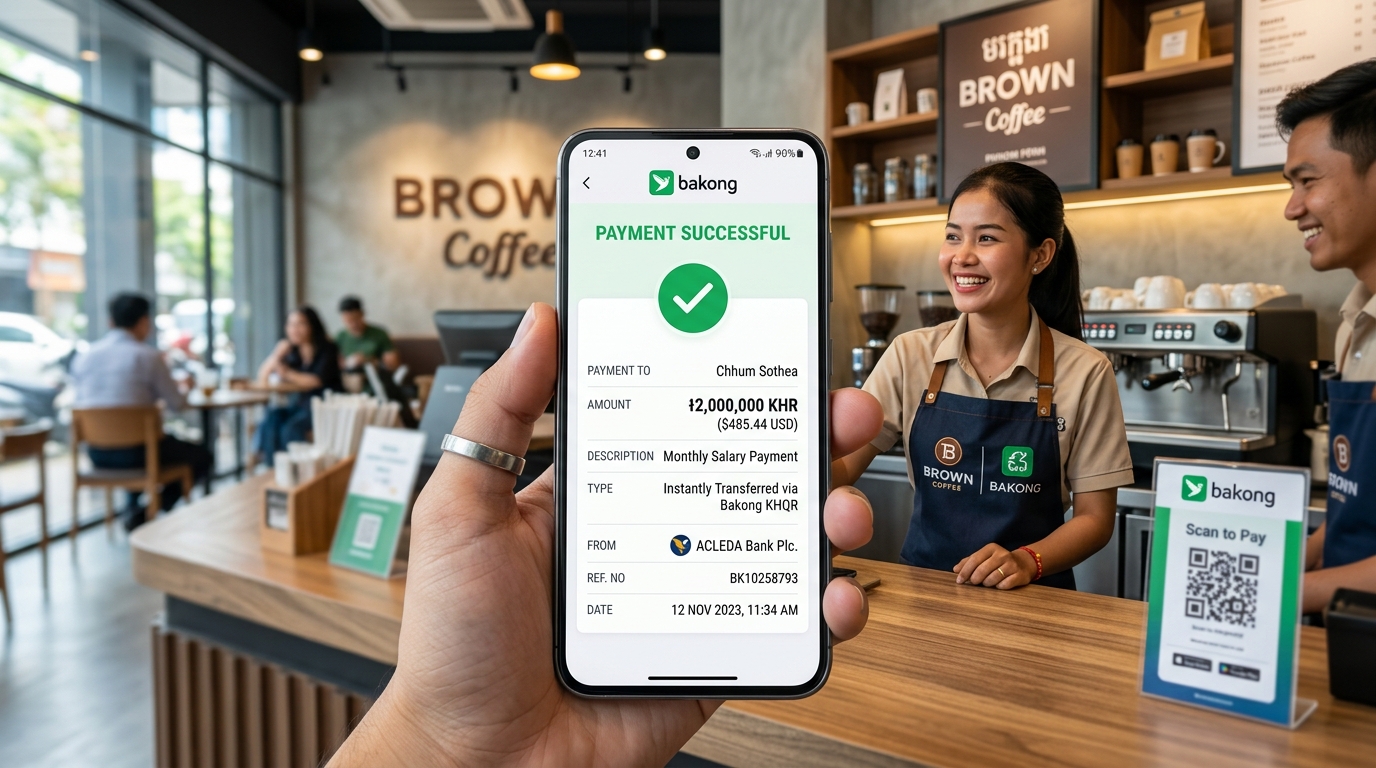
The verified overtime amounts flow directly into AttendKH Payroll Engine. The system generates clear bilingual (Khmer/English) payslips showing exact regular hours, overtime hours by rate category, gross wages, NSSF contributions, and GDT Tax on Salary deductions, ready for one-click bulk payment via NBC Bakong KHQR.
4. Cambodian Statutory Overtime Multipliers & Hourly Rate Formula
To verify that your payroll calculations are 100% compliant with Ministry of Labour regulations, use this statutory reference guide:
| Overtime Scenario | Statutory Reference | Legal Pay Multiplier | Practical Calculation Example (Base Wage: $260/mo) |
|---|---|---|---|
| Normal Working Day Overtime (e.g. 17:30 – 19:30) | Article 139 | 150% (1.5× Base Hourly Rate) | Base Hourly Rate: $1.25 → $1.875 per hour |
| Night Shift Overtime (22:00 – 06:00) | Article 139 & 144 | 200% (2.0× Base Hourly Rate) | Base Hourly Rate: $1.25 → $2.50 per hour |
| Weekly Rest Day (Sunday or assigned rest day) | Article 147 & 149 | 200% (2.0× / Double Pay) | Base Hourly Rate: $1.25 → $2.50 per hour |
| Official Public Holidays (Royal Decree calendar) | Article 164 | 200% (2.0×) + Regular Holiday Wage | Base Hourly Rate: $1.25 → $2.50 OT + $1.25 Base = $3.75 total/hr |
The Statutory Hourly Rate Conversion Formula
Under MoLVT standards, the standard monthly base salary is converted to an hourly rate using 26 working days per month and 8 working hours per day:
Hourly Rate Formula:
Base Hourly Rate = Monthly Base Salary ÷ 26 Working Days ÷ 8 Working Hours
For an employee earning a base salary of $312.00 USD per month:
- Daily Rate = $312.00 ÷ 26 = $12.00 USD / day
- Hourly Rate = $12.00 ÷ 8 = $1.50 USD / hour
- Regular Overtime Rate (1.5×) = $1.50 × 1.5 = $2.25 USD / hour
- Holiday/Sunday Overtime Rate (2.0×) = $1.50 × 2.0 = $3.00 USD / hour
5. Audit Trails & Overtime Evidence for MoLVT and BFC Inspections
Cambodian labor inspectors and international social compliance auditors (such as Better Factories Cambodia) scrutinize overtime records with intense rigor. During an audit, your company must produce:
- Documented Employee Consent: Proof that overtime was voluntary and not coerced under duress.
- Daily Shift Limits: Affirmation that no worker exceeded the mandatory statutory ceiling of 2 hours of overtime per day.
- Punched Evidence Matching Payslips: Verifiable correlation between physical clock-in/out timestamps and the overtime figures reported on monthly wage sheets.
- Adequate Rest Periods: Evidence that workers received at least 11 consecutive hours of daily rest between shifts under Article 144.
Maintaining physical paper binders of handwritten sign-off slips for 50+ employees over five years is an administrative nightmare prone to water damage, misplaced records, and audit write-downs.
With AttendKH Cloud Storage, every clock punch, GPS coordinate, live selfie, manager approval timestamp, and hourly wage calculation is archived in an immutable, searchable cloud database. When an inspector requests records for March 2025, HR can export a certified PDF audit trail in under 10 seconds.
6. How AttendKH Eliminates Overtime Payroll Mistakes
Manual spreadsheets have cost Cambodian businesses tens of thousands of dollars in overpaid overtime, employee grievances, and regulatory fines. AttendKH re-engineers this process from the ground up:
- Automated Geofenced Attendance: Staff clock in on mobile within authorized branch perimeters or at front-desk tablet kiosks.
- Telegram Bot Instant Approvals: Shift supervisors approve or reject overtime requests directly within their branch Telegram chat in real time.
- Built-in Cambodian Statutory Engine: Automatically applies 1.5×, 2.0×, public holiday calendars, GDT salary tax brackets, and NSSF ceilings without formula programming.
- Bilingual Automated Payslips: Generate clear Khmer and English digital payslips delivered straight to employees' phones via Telegram or SMS.
- Direct Bakong KHQR Disbursal: Execute one-click batch salary payouts to ABA, ACLEDA, Canadia, and 50+ partner banks with zero transaction fees.
Take Control of Your Payroll Today
Eliminate manual calculations and ensure 100% statutory compliance. Discover how AttendKH Payroll and AttendKH Attendance modernize workforce operations for just $1 USD per employee per month. Explore our transparent pricing plans, download the apps, or contact our Phnom Penh team to start your free 14-day company trial today.